Chapter 02·8 min read
Designing Journeys
Every successful journey begins long before the first guest arrives.
The project
Ringtours Vision · Nouvelles Frontières / World of TUI · Beckers Travel.
Tourism product development, FIT and groups, VIP, incoming operations, MICE, destination marketing, hotel sourcing, excursions and experiences, FAM trips and international supplier coordination.
The objective
To turn a country into an experience — and to do it in the guest's own cultural language, not ours.
My role
Programme design, product development, operations, on-the-ground coordination, cultural translation between markets, agencies and suppliers.
Every successful journey begins long before the first guest arrives.
I listen carefully from the very first conversation. I anticipate needs, connect people and find solutions before they become visible.
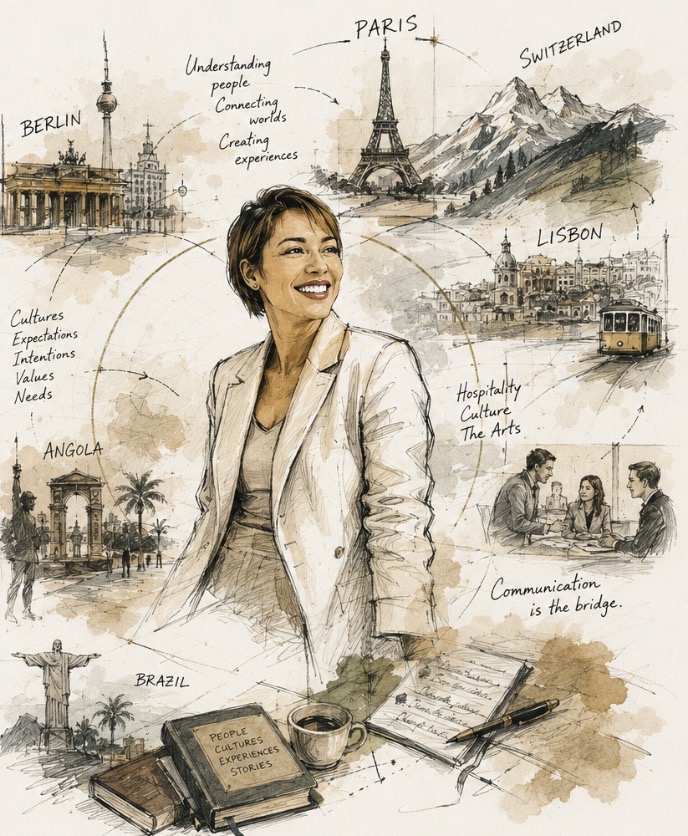
Paris. Rio de Janeiro. Berlin. Three cities, one evolving craft — and the focus was always tourism marketing: assembling VIP travel packages, coordinating incentive groups, promoting destinations and building their online presence — until travellers came home enchanted.
Part One — Designing the Journey. Ringtours Vision, Paris.
As product developer — forfaitiste — my desk was covered in maps before it was ever covered in guests. I spent months researching destinations, negotiating with hotels, contracting local partners, and assembling tailor-made travel packages for the Latin American B2B market. My clients were travel agencies, not travellers. The traveller only appeared later, in the memory the itinerary would eventually leave behind.
Product development taught me that an itinerary is written twice — once on paper, and once in the guest's memory. The two versions rarely match, and the second is the only one that counts.
Part Two — Bringing Destinations to Life. Nouvelles Frontières / World of TUI, Paris.
The shift was subtle but decisive: from designing tourism products to receiving the people who would live them. Incoming operations, destination management, tourism marketing, on-the-ground coordination. I stopped writing itineraries and started answering the question every itinerary silently asks — does the country deliver what the brochure promised?
This is where I first understood destination management as a form of hospitality with a wider room. The lobby simply happens to be a whole country.
Part Three — Welcoming the World. Beckers Travel, Berlin.
At Beckers I was Project Manager for the Latin American market — tailor-made FIT, groups, VIP and MICE programmes throughout Germany. My clients were travel agencies and corporate partners across Latin America; my daily language was a mixture of Portuguese, Spanish, German and English, and the work was to make all four feel like one.
The role covered the entire destination management chain: understanding the client's objectives, programme design, hotel sourcing and contracting, transportation, excursions and cultural experiences, restaurants and venues, multilingual coordination, supplier management, operational follow-up, and — always — problem solving in the space between plan and reality.
A group arriving from Tokyo does not want the same day as a group arriving from São Paulo. Same city, same coach, entirely different journey. The work was less about logistics and more about listening. What a French incentive group considers luxury; what a German corporate group considers respect; what an American FIT considers a good story to bring home.
Featured project — Volkswagen international launch.
A large international automotive launch is a hospitality event dressed in marketing. Hundreds of international guests, several markets converging on Germany, one narrative to protect from the airport to the last night's dinner. My responsibility was to coordinate the Brazilian market within the wider MICE programme — the arrivals, the transfers, the hotel choreography, the cultural interpretation between a German host and a Brazilian guest whose expectations of a car reveal are not remotely the same. (Programme details — vehicle model, dates, exact attendance — to be verified together before publication.)
What the project taught me was not logistics. It was that at a certain scale, hospitality is the only discipline capable of holding a launch together — because everything else is already covered by professionals, and what remains is the human weather.
From product to experience
Before
A tailor-made package on paper — hotels, transfers, excursions, prices.
After
A group returning home already recommending the destination to the next travel agency, without being asked.
What I learned
Destination management is not about moving people from one place to another. It is about understanding cultures, anticipating expectations and quietly connecting every detail so guests can simply enjoy the journey.